
Just Ask Benji: An AI navigator tells the stories of families in need
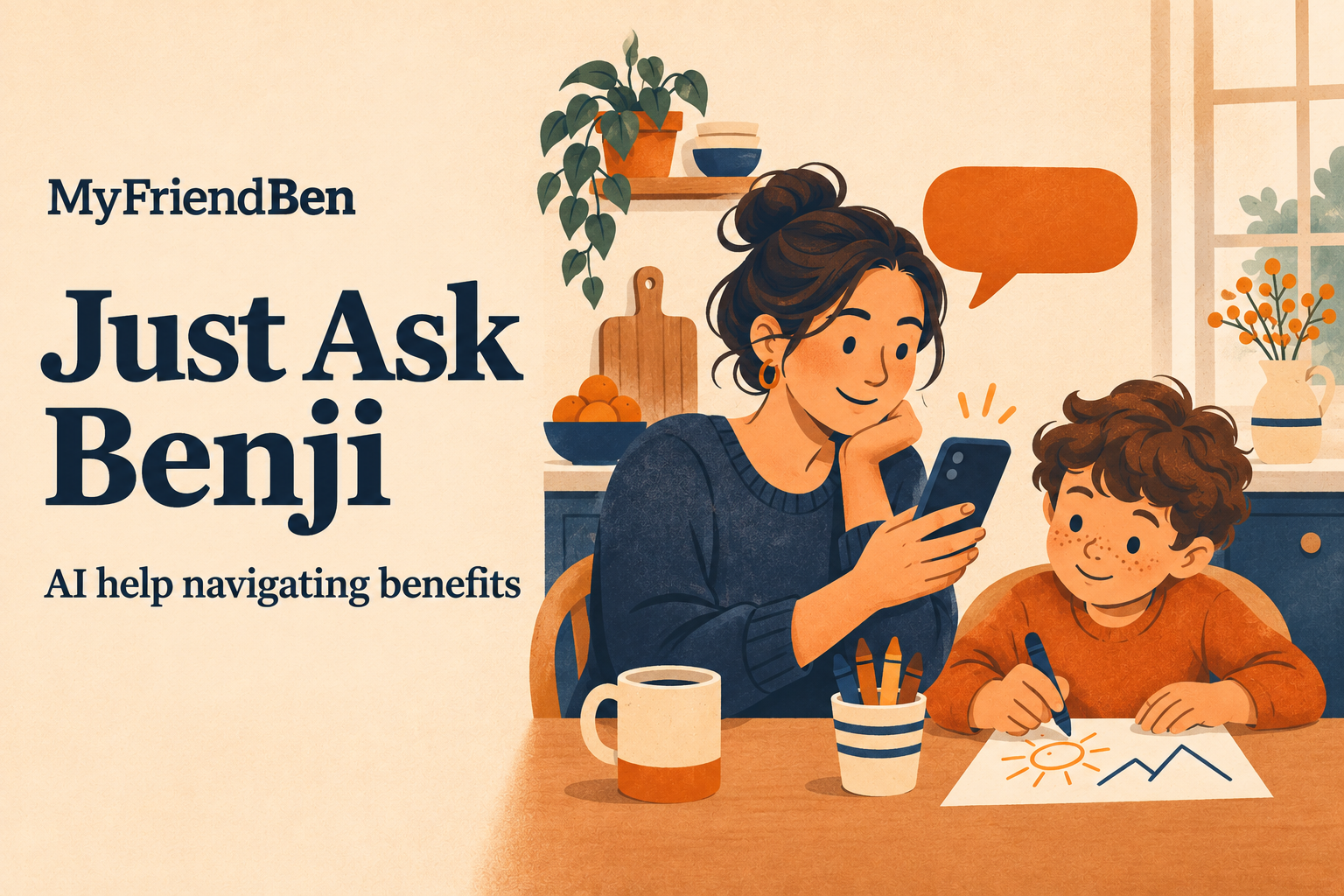
Benji is MyFriendBen’s AI navigator. Launched in September, it currently lives on a family’s results page, already knows what they are eligible for, and answers in whatever language they write in. Every week, an automated report tells us how it did. Every week, we read the exchanges, improve the tool, and learn about the process every family in need experiences. With these stories and data, we are designing the future of benefit navigation the only way MFB ever does: with people first.
1,499 households in one week, across seven states and six languages. Illinois led with 439 conversations, then Colorado (304), Washington (231), Texas (230), Missouri (200), Kansas (70) and Massachusetts (25). Forty-eight conversations were in Spanish, and a handful more in Portuguese, Arabic, French and Russian. Nobody flipped a switch. Partners put Benji in front of the people they serve, and those people brought their hardest problems with them.
Rent is the number one topic. It has been number one every single week. Rent and housing assistance has topped the list in every weekly report, followed most weeks by homelessness and emergency housing and utility bills. When someone asks Benji about a program that isn’t in their screening results, the most common one, week after week, is rent or mortgage help. That gap is itself a finding: it tells us and our partners exactly where the benefits system has the fewest doors.
A senior who lost his livelihood to a workplace injury didn’t write in about rent, though. He wrote in because Social Security still believed workers’ comp was paying him, so his disability check had shrunk to a fraction of what he was owed. He had sent every document he had. He didn’t know computers. The lawyers he called only wanted to win him benefits he had already won. Benji named the actual problem, a workers’ comp offset that needed correcting, and pointed him to the state’s free disability legal aid that handles exactly that. Then it kept going: mortgage help he had been told didn’t exist for homeowners, and a transit discount for people on disability he had never heard of. His reply: "I did not know that. I will do that this morning."
98% of checkable claims were accurate. Every week, an automated audit pulls 100 conversations and checks every factual claim Benji made against the household’s own screening results and program content. That week it checked 253 claims and found 4 wrong. Across more than 1,200 claims checked to date, accuracy averages 98%. We publish the misses alongside the wins because that is the only way to earn trust at this scale.
Zero invented phone numbers. Two flagged links for review, out of thousands. The same audit flags any link or phone number that did not come from the household’s results. In a week when Benji gave out hundreds of phone numbers and links, two links were flagged for review, and no phone numbers. The thing we worried about most, an AI confidently sending someone to the wrong door, is the thing the data shows least.
Some of that comes from Benji being willing to say no. A Colorado parent, several months out of work after a medical crisis, needed one thing above everything else: the car fixed, to get the kids to school and to appointments before winter. There is no car-repair program in their results, and Benji said so plainly rather than inventing one. What it could offer was a bridge, a transit program that covers school runs and appointments, and a referral to 211 for local repair help. Across the week, Benji also declined to guess at a property-tax exemption, a case status at a legal aid office, and a document checklist it didn’t have. Every one of those was a chance to sound helpful and be wrong. It took none of them.
93% thumbs up. Of the 204 people who have rated a conversation, 190 gave it a thumbs up. In this one week, 119 of 128 did. Most people never rate at all, which is normal, so we read transcripts by hand every week too. We are learning all the time from the folks willing to trust our technology and tell us their stories.
Median response: 2.6 seconds. Errors: 3 out of 4,541 messages. Speed matters more than it sounds. About a third of MyFriendBen users screen at night, when no navigator is on the clock, and a person with a toddler and an eviction notice does not wait for a spinner.
A grandparent waiting on knee surgeries, living in an RV that no longer runs, and babysitting several young grandchildren asked Benji if they could "schedule a time." Benji can’t schedule anything, and said so. But it explained that the disability application saves as you go and can be finished when you have a moment to yourself, warned that a first-time denial is normal and not the end of the road, and sent a short list of documents to have ready. The conversation ended with "Happy Holidays to you & yours."
Median conversation: two exchanges. One in three people ask one question and leave. That is not a failure. Most people come with one question, get the answer, and go apply. The longer conversations are the ones where life is complicated, and those are where Benji earns its keep.
In one of them, in Spanish, a parent of several children who had fallen ill and was many months behind on rent, eviction notice in hand, asked where to go for help. Benji walked them through free eviction legal aid first, because that is the piece with a deadline, then rental assistance, step by step. When they asked which documents to bring, it said honestly that it didn’t have that list and told them who to call to confirm.
What the numbers can’t tell us. Most people don’t write back. The injured worker, the parent with the car, the grandparent in the camper: we don’t know whether they made the calls. We would rather tell you that than pretend otherwise. What we can say is that the first step was clear, the deadline was named, and the door was pointed to. In a crisis, that is the part people are missing.
Benji is the navigator in your pocket: sort the pile, point to the first step, be honest about what it doesn’t know, and be there when you come back. Screen in about six minutes at myfriendben.org.
Related Posts
United Way of Metro Chicago Expands Access to Public Benefits Through 211 Metro Chicago and MyFriendBen
In the News211 Metro Chicago uses MyFriendBen Illinois to screen Cook County residents for public benefits and connec…
Read More »
MyFriendBen and United Way 211 Launch in Kansas and Missouri
In the NewsSix, free, confidential minutes help families find assistance they qualify for food, housing, healthcare a…
Read More »
Urban Institute Evaluation Shows MyFriendBen’s Impact on Benefits Access
In the NewsIn 2026, the Urban Institute released an independent evaluation of MyFriendBen based on its implementation…
Read More »